Server security updates: one week across dozens of servers
Four published flaws, dozens of servers, one week: what automatic updates fixed on their own, and what needed a reboot and a person.
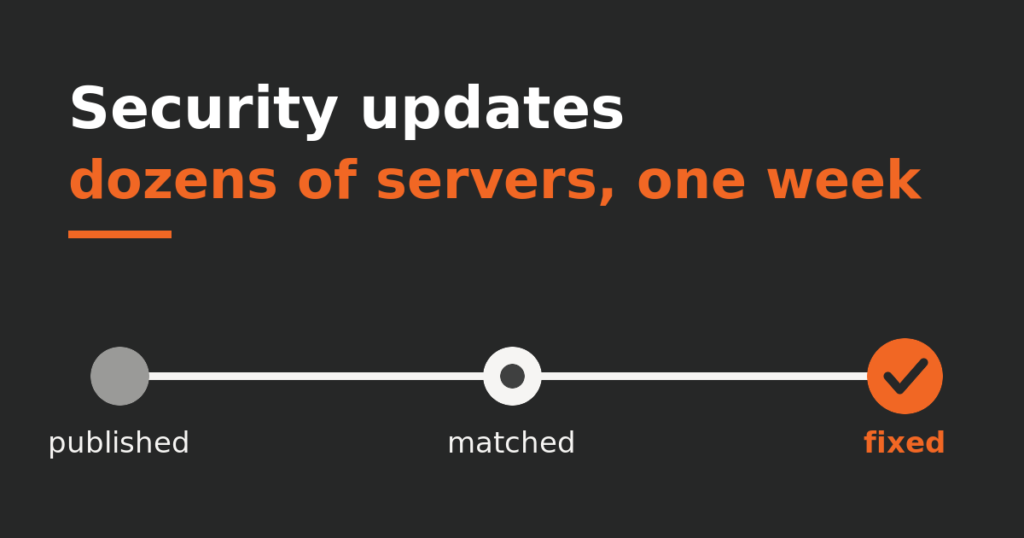
Most advice about server security updates ends at “turn on automatic updates”. This is our own log of one week, 9 to 17 November 2026: dozens of servers at several providers, among them Hetzner, Google Cloud, Azure and Jetserver, four published flaws, and what the automatic part did and did not do.
How we know which server security updates matter
Every project we run has a screen in Butler, our AI development cockpit. On 9 November we added a tile to it called “Server updates”. Every six hours it reads the pending packages on each server, matches them against the security notices of the system’s publisher, and colours the server. Red means a fix rated high has waited more than two days. Nobody compiles the list of affected servers after reading the news. It is on the screen, and a red server raises an alert.
The first alert was half wrong. It showed many security fixes waiting on one server. That server’s automatic updates had in fact run four days earlier: the tile was reading a stale copy of the package list from inside a hosting container. A few real fixes went in that day, and the tile now takes its reading from the host itself.
Four flaws, from published to fixed
- Web server, 3 November. LiteSpeed published a build whose changelog reads “Address a critical LSQUIC vulnerability” (the part that speaks HTTP/3), with public disclosure set for 16 November. On 12 November we checked: the servers we looked at already ran a fixed build. On most of them we installed the next build too, and found that the update script had left the old program running until someone restarted it.
- Linux kernel, 10 November. Ubuntu’s notice USN-9022-1 ends with a reboot. Automatic updates install a kernel, but they cannot start using it. Reboots were scheduled on 12 November and ran on 13 November, just under three days after the notice.
- C library, 12 November. USN-9065-1 arrived hours before those reboots. Most servers had it installed and loaded within 16 hours. A few took four days or more.
- SoS diagnostic tool, 16 November. USN-9093-1 was applied on several servers the same day, with no reboot.
The night of the reboots
Several servers got a one-shot timer, five minutes apart from 03:00 UTC, each expected to be down for one to three minutes, each cancellable with one command. Before that, we checked that the graphics driver of a server that processes camera video supported the new kernel. By 06:08 most of the servers had rebooted. At 05:21 the tile had turned green for the first time: no security updates pending.
It was not a clean night:
- Several servers rebooted more than once, because the C library fix was installed after their first reboot.
- After the reboot of a server shared by several sites, the logins of a few sites landed in an empty container. Their dashboard tiles were blind for about two hours, until one more reboot.
- A control panel upgrade done the same night reopened several firewall ports on one server. We closed them again the same night.
- The same pass found the database port open to the whole internet on a few servers. It was closed that night, with a list of allowed addresses.
Before that week: a serious PHP flaw
This log starts on 9 November, but the routine behind it was shaped by an earlier and more serious case: a critical vulnerability in PHP, the language most of the sites we host run on. It is not in this log, so we give no dates here.
Butler analysed the advisory as soon as it appeared, before any fix existed. While waiting, we applied temporary protections: configuration settings that close the door the flaw needs. A few were our own, and others followed the unofficial information that kept arriving, none of it confirmed yet. When the PHP project released the real patch, it was on our servers 15 minutes later. In parallel, within 24 hours, we moved every legacy system that was still on an old PHP version to a supported one, so that none was left out of reach of the fix.
Unconfirmed protections are a judgement call: a setting that blocks an attack can also break a working site.
The slowest server was our own
The slowest server was Butler’s own. Its update job had hung for about two and a half days, so the C library fix never arrived. The tile showed amber, “lists 3 days old”, on 15 November. The job was cleared on 16 November and the reboot ran at 3 a.m. Mexico City time on 17 November, almost five days after the notice.
Where the person came in
Butler has no administrator rights on these servers. The manual updates and the reboots went through the owner’s own computer. The reboot of a store’s web server waited for his approval, and the extra reboot of the shared server was done on a person’s request. The rule behind the whole week is also a person’s choice: updates install themselves, reboots never do. It is one of the moments where a person must say yes.
What to ask about your own servers
Who can tell you today which servers have a security fix waiting, and for how many days? Who decides when a server reboots? When was the last time someone checked that the automatic update really ran? This is our log, not security advice for your setup, and a server that holds sensitive data deserves a specialist’s review. It is how we run managed servers and hosting and our security response, next to the checks in two weeks of website and server monitoring. To go through your servers with us, book a free 30-minute consultation and project review.
Keep reading
 Expert talent
What an experienced developer does when AI writes the code
When AI writes the code, three jobs stay with a person: knowing what to ask for, spotting a wrong answer, and deciding what not to build.
 Field notes
How we automate bookkeeping so no invoice gets skipped
A field note from our own books: three AI routines chase tax invoices and check month-end gaps, a tile flags unpaid invoices. Real counts.
 Human in the loop
Automate customer support with AI: what waits for a person
Two AI agents read app reviews and guest messages every day. What they answered by themselves in November, what waited for a person and what is still open.